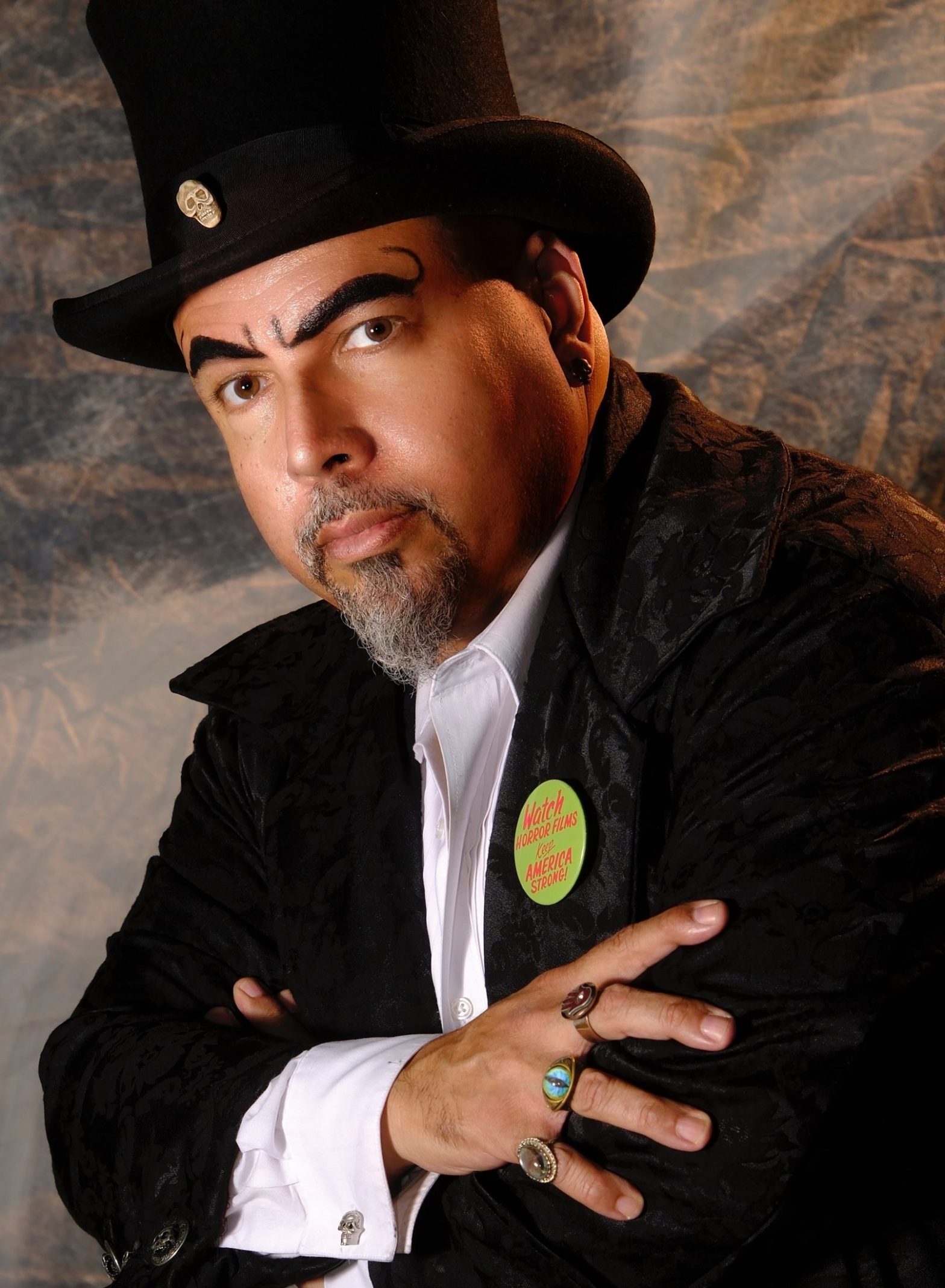
Every great myth begins in darkness, but for Frank Wallace Aylesworth, it began in the blue-tinted living rooms of Northern California.
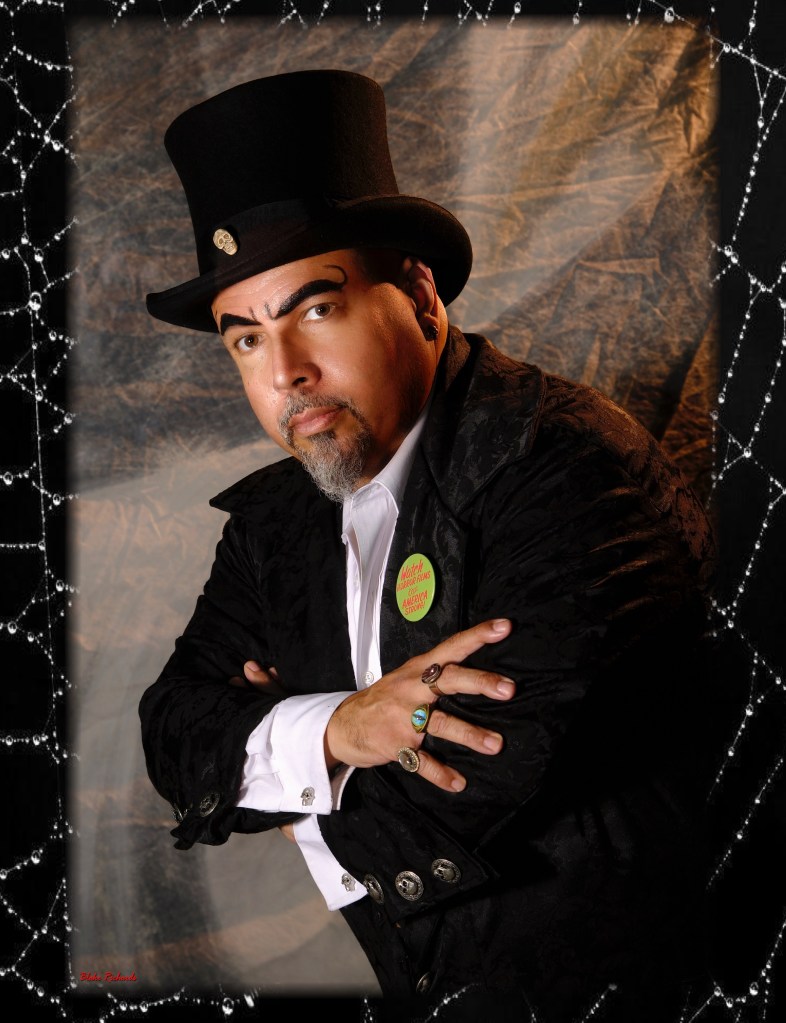
Long before donning the theatrical robes of Lord Blood-Rah—the syndicated television host, live-stage raconteur, and beloved champion of classic cinema—Frank was simply a boy captivated by the magic of late-night television. To understand who Lord Blood-Rah is, one must understand the golden lineage of regional horror hosting that raised him.
In an extensive sit-down with broadcaster, theatre veteran, and producer Jay Michaels ahead of the Out of the Cellar Horror Film Festival, Frank opened up about his unexpected evolution from an ordinary genre geek into one of independent broadcasting’s most enduring and heartfelt figures.
The School of Bob Wilkins and John Stanley
For those who came of age during the heyday of local broadcast television, Saturday night wasn’t merely a time slot; it was sacred ground. While East Coast kids like Jay Michaels were tuning into Channel 5, 9, and 11 for Creature Features, Chiller Theatre, and Fright Night, Frank was glued to KTVU Channel 2 in the San Francisco Bay Area.
There sat Bob Wilkins, the dry-humored, cigar-chomping everyman who redefined the art of horror hosting. Wilkins didn’t dress like a vampire or cackle into a cauldron; he sat in a yellow rocking chair with an unlit cigar, treating bizarre low-budget films with gentle wit and infectious charm. When Wilkins retired, the mantle was passed to author and historian John Stanley, who carried the torch through the 1980s.
“They opened up the entire world of horror, science fiction, the Universal classics, Hammer films, ’50s atomic sci-fi, and Godzilla,” Frank reflects. “That’s essentially what horror hosts do: introduce audiences to these films and take them by the hand through fantasy realms.”
Yet, unlike performers who grew up harboring showbiz ambitions of lurking behind a candelabra, Frank never considered putting on a costume. “If someone had told me twenty years ago that I was going to be a horror host, I would have told them they were completely insane.”
The Spark at Chouinard Vineyards: A Ten-Year Genesis
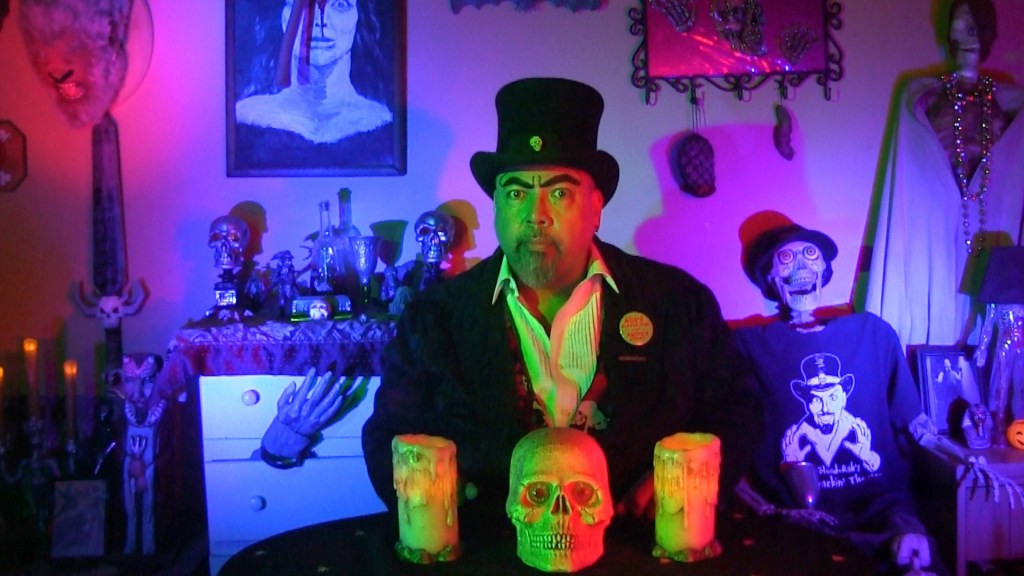
The path to royalty began not on a television soundstage, but among the grapevines of Castro Valley.
Frank and his wife were close friends with winemaker Damian Chouinard of Chouinard Vineyards. One evening, Frank introduced Chouinard to Edward D. Wood Jr.’s 1959 cult monument, Plan 9 from Outer Space. Chouinard, astonished that such wonderfully earnest cinematic oddities existed, was immediately smitten: he wanted to project the film under the stars at the winery.
Frank agreed, but insisted on one crucial rule of creature-feature etiquette: “You can’t just show the movie. You’ve got to have someone introduce it, share the lore, and present shorts.”
An outside host was brought in for that first screening, but behind the scenes, the evening unraveled into logistical chaos. The following afternoon, Chouinard, Frank, and Frank’s wife sat around the table with glasses of wine. Chouinard loved the audience’s reaction and was eager to turn the screenings into an ongoing festival series, but needed a host who possessed genuine knowledge, reliability, and respect for the audience.
Frank scratched his head, admitting he didn’t know anyone locally to recommend.
At that moment, Frank’s wife cut through the room: “Well, why the hell don’t you do it?”
“There was an imaginary clap of thunder, and somewhere in the distance a wolf howled,” Frank remembers with a grin. “And in 2009, Lord Blood-Rah was born.”
What began as an informal experiment became a celebrated ten-year residency at Chouinard Vineyards. Frank screened vintage prints, mingled with local movie lovers, and crafted a signature stage presence. By 2013, the live phenomenon transitioned into syndication with the television series Lord Blood-Rah’s Nerve Wrackin’ Theatre, carrying Frank’s warm commentary into commercial television markets across Illinois, Indiana, California, and online platforms.
The Anatomy of an Aristocrat: An Autologous Blood Draw
The birth of Frank’s regal persona is an infamous story of pure serendipity.
Years prior to his first show, an acquaintance working on a college project had asked Frank to brainstorm potential horror host aliases. While waiting in line at a San Francisco comic book convention, Frank’s cell phone rang. It was a local hospital calling to schedule a pre-operative procedure: an autologous blood draw—a standard process where a patient donates their own blood ahead of surgery.
Frank froze, hanging up the phone with the medical phrase echoing in his mind. What a name: Autologous blood draw.
To create the character, Frank took “blood draw” and respelled it with a hyphen and a silent flair: Blood-Rah, lending it a mysterious, archaic, Egyptian aura reminiscent of Boris Karloff’s The Mummy.
As for the title? Every traditional horror epithet was taken. “Mister, Doctor, Professor, and Count were all claimed,” Frank explains. He chose Lord for two reasons: its regal cadence, and as an homage to the legendary 1950s counter-culture hipster comic Lord Buckley.
Buckley famously translated classic literature and historical lore into the slick cadence of beat poetry, preaching that there is “nobility in gentility”—that anyone who treats their fellow human beings with kindness, empathy, and dignity is royalty.
“That’s why I always address my audience as ‘my lords and ladies,’” Frank explains. “Because all of us geeks are lords and ladies. We’re on an equal footing. Lord Blood-Rah is never aloof, and he never talks down to his viewers.”
The Gospel of “Bad” Cinema: Why Making a Movie is a Miracle
Spend ten minutes talking with Frank, and it becomes obvious that behind the velvet cape sits a serious film historian. He views horror not as low-rent entertainment, but as modern folklore that mirrors the psyche of civilization.
“Horror resonates with primal human fears,” Frank observes. “The original novel of Dracula in the 1890s was an allegory for Victorian fears of foreign invasion, disease, and sexual liberation invading a repressed empire. Frankenstein is subtitled The Modern Prometheus. Godzilla was born directly out of the national trauma of the bombings of Hiroshima and Nagasaki. The giant mutant ants and irradiated creatures of the 1950s reflected the dread of Cold War nuclear fallout.”
Yet, Frank’s greatest gift is his fierce defense of low-budget, so-called “bad” cinema. While hosts like Elvira or the crew of Mystery Science Theater 3000 built legacies on skewering clumsy movies, Frank takes an entirely different philosophical approach.
He will poke fun at a boom microphone dipping into a frame or a wobbling cardboard tombstone, but he steadfastly refuses to demean the artists who made them.
“Making a movie is a miracle in itself,” Frank emphasizes. “Anybody who tackles trying to make a film—no matter what kind of a horrible hash they make out of it—they made a film. Does anybody really believe Ed Wood was the worst director in history? Of course not. You can feel his pure love and enthusiasm in every frame of Plan 9.
To me, the worst film ever made is a movie that premiered at a Southern drive-in, ran for a single week, and disappeared forever because it was so boring and devoid of spirit that nobody ever spoke of it again. If a film made sixty or seventy years ago is still being watched, laughed with, and enjoyed by an audience today, it is not a bad film. It has real entertainment value, and that makes it a good film.”
More Than a Monster: The Friend in the Screen
For Frank, the most meaningful chapter of his journey hasn’t been ratings, syndication deals, or festival awards—it has been the quiet, unexpected moments where his show provided solace to people in their darkest hours.
During his ten-year television syndication run in the Midwest, Frank received a letter from a man in Illinois. The viewer wrote to say that his wife was undergoing aggressive chemotherapy treatments, and that watching Frank’s broadcast together was the very first time he had heard her laugh in weeks.
Years later, while appearing at a convention in Illinois, the couple approached his table. The woman was fully in remission.
“We stood there and hugged, and I was just overwhelmed,” Frank says, his voice softening. “I’m making this show simply because I love these movies and want to share them. But realizing that this silly, fun show could pierce through someone’s real-world pain and bring them relief… that completely floored me.”
At another appearance in Fort Wayne, a young man waited in line just to tell Frank: “I grew up watching your broadcast, and it was one of the few happy memories I ever shared with my father.”
“That is what a horror host is supposed to be,” Frank reflects. “It’s like sitting on the couch watching a movie with a friend—a friend who happens to know a lot of behind-the-scenes trivia, guiding you through the spooky parts with a smile. If you’re going through a tough time in your life, having a friendly face on that screen can make a difference.”
Celebrate the Legacy: Out of the Cellar Horror Film Festival
Frank Wallace Aylesworth brings Lord Blood-Rah back home to his roots this November for the inaugural Out of the Cellar Horror Film Festival, hosted at the landmark single-screen Chabot Theater in Castro Valley, California.
Running across Friday the 13th and Saturday the 14th of November 2026, the boutique festival celebrates indie filmmaking, practical effects, and classic horror culture:
- Friday, November 13 (Creature Features Night): Lord Blood-Rah headlines alongside internet horror hosting pioneer Count Gore De Vol for a tribute to midnight cinema, complete with classic screenings, filmmaker Q&As, and audience interactions.
- Saturday, November 14 (Festival Showcases & 48-Hour Challenge): Frank returns to host curated blocks of local and international independent horror shorts, alongside the screening of submissions from the OOTC 48-Hour Filmmaker Challenge.
Tickets, screening times, and passes are available now. Due to single-screen theater capacity, advance booking is recommended at outofthecellarfilms.com.